
The Ballet of the Good City Sidewalk
from The Death and Life of Great American Cities (1961)
by Jane Jacobs
"The ballet of the good city sidewalk never repeats itself from place to place, and in any one place is always replete with new improvisations."
Passage:
This order is all composed of movement and change, and although it is life, not art, we may fancifully call it the art form of the city and liken it to the dance — not to a simple-minded precision dance with everyone kicking up at the same time, twirling in unison and bowing off en masse, but to an intricate ballet in which the individual dancers and ensembles all have distinctive parts which miraculously reinforce each other and compose an orderly whole. The ballet of the good city sidewalk never repeats itself from place to place, and in any one place is always replete with new improvisations.
Dull, inert cities contain the seeds of their own destruction and little else. But lively, diverse, intense cities contain the seeds of their own regeneration, with energy enough to carry over for problems and needs outside themselves.
Biography & Abstract
Jane Jacobs (1916–2006) was a journalist and activist with no formal degree in urban planning, which is precisely what made her dangerous. The Death and Life of Great American Cities (1961) was written in direct opposition to the prevailing orthodoxy of mid-century urban design, which held that cities should be planned from above according to rational principles of order and efficiency. Jacobs watched her own neighborhood, Hudson Street in Greenwich Village, and described what she actually saw: a self-organizing ecosystem of storekeepers, residents, and strangers whose daily movements created safety, trust, and vitality that no master plan could replicate or replace.
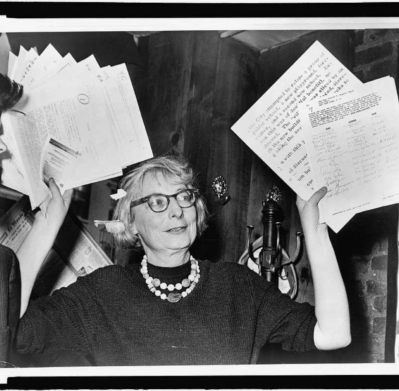
Mrs. Jane Jacobs, chairman of the Comm. to save the West Village holds up documentary evidence at press conference at Lions Head Restaurant at Hudson & Charles Sts
Her argument is structural: cities are not machines to be engineered. They are ecosystems sustained by diversity of uses, of users, of building ages, of economic activity at different hours of the day. Planning that pursues order over complexity does not merely fail to create this diversity. It destroys the conditions under which diversity could generate itself. What she called the sidewalk ballet cannot be designed. It can only be enabled or disabled by the infrastructure built around it. When that infrastructure optimizes for efficiency over use, the ballet stops. And when the ballet stops, the city begins to die, not dramatically, but quietly, block by block, as the conditions for spontaneous human exchange are removed one by one.